ORIGINAL: ModernGuitars.comby
Ray MinhinnettIntroduction (July, 2005)
Tragically, guitarist and singer
Rory Gallagher (March 2, 1948 - June 14, 1995), was taken from us far too early, and although he left an incredible legacy and body of work, his wonderful and unique presence is sorely missed on the performance circuit everywhere and by countless faithful fans throughout the world.
Rory was a shy, simple soul, a man of few words but of amazing depth and integrity. He was a man who would never compromise his musical beliefs, direction, or what he believed to be right. A man who was a far better guitarist and who had a hell of a lot more talent than most of the people that have enjoyed more commercial success.
The interview that follows was conducted a year or so before Rory's passing, and its introduction written shortly after my meeting with Rory at a hotel in Chelsea. At the time, I had written a movie about the Fender Stratocaster that would become
Curves, Contours and Bodyhorns, and my interview with Rory was to further the research that went into the making of the film. Sadly, a few short years later, in 1996, I would screen the film during my presentation of the
Rory Gallagher Memorial Lecture at the University of Cork at the behest of Rory's brother, Dónal.
It's now been a full decade since Rory left us. Over these ten years, interest in and love for the man and his music has grown tremendously, which has prompted me to share this interview with the many who miss him and will take his words to heart.
 Interview with Rory Gallagher (circa 1994)
In a cab on my way down to the Chelsea Embankment to meet with
Rory Gallagher, my mind drifts back to the first time I saw Rory play live. I had just started to play guitar myself, an old battered single pickup Broadway electric bought for eight Pounds for me by my Gran. The gig was at the weekly Sunday night Jazz n' Blues Club at the
Argus Butterfly Pub in Peterlee County, Durham.
By this time, I had bought the now infamous albums by
John Mayall, Blues Breakers with Eric Clapton, and
A Hard Road with Peter Greene, so I had been a blues fanatic (or so I thought at the time) for a few years. Even so, I was just starting to hear songs by Howlin' Wolf, Freddy, Albert, and B.B. King, Robert Johnson, Otis Rush, and Muddy Waters. These recordings were very thin on the ground - not easily available in local record shops of Northeast England mining towns.
Jimi Hendrix had pushed the Stratocaster sound to the forefront, but apart from Hendrix, all my mentors were using Gibsons and I was hooked on the sound of the
Gibson Les Paul. However, I was hungry to learn, and was always on the lookout for new exciting guitar players. I had heard of Rory and his group,
Taste, through the grapevine and was really looking forward to seeing him, despite the fact, as went my thinking at the time, he played a Strat.
Taste walked onto the stage at around nine that night.
Ritchie (Charlie) McCracken looked lanky, disheveled, and like his white Fender Precision Bass was too small for him.
John Wilson ambled on and took a seat behind his kit without any fuss, and then a diminutive figure in jeans and a brown tartan wrangler shirt shuffled onstage
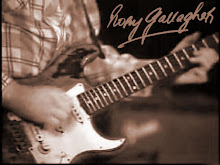
carrying the most battered Strat I had ever seen. Even back then, it looked like it had spent its life on the streets of a war zone. Rory plugged into the
AC30 amp and away they went.
I couldn't believe it. Taste was fantastic, coaxing incredible sound from the bare essentials: McCracken's Triumph bass amp and Rory's Vox AC30, his Strat and one effect, a Range Master Treble Boost.
Brian May has since told me that not only was Rory his main inspiration and favourite guitarist, it was from Rory that he got the idea to use Vox AC 30s and the Range Master Treble Boost.
Taste sounded enormous, and what a guitar player. Rory was obviously something very special.
I have never forgotten that night. Rory left a hell of an impression on me - as he did with every audience and person he met. We bumped into one another from time to time on the road when I was playing with Frankie Miller's Full House - mostly in Europe - and though I didn't get to know him really well,
I loved the soft sincerity of the man and the depth of his musical knowledge, not only of the blues, but folk music, guitar tunings, and Celtic music. He was incredible, and in the mid-Eighties, when "Big" Charlie McCracken played with me in both The Diesel Band and my own band, we often talked about that first night.
And now, here I am, twenty-five years later, on my way to a Hotel in Chelsea Harbour to interview Rory for a film I had written and was producing on the history of The Fender Stratocaster.
Ray Minhinnett: How did you start, Rory? What motivated you? Talk about your early influences.
 Rory Gallagher:
 I was actually more interested in acoustic music before electric. I loved
Leadbelly,
Josh White, and I had a great admiration for
Woody Guthrie and people like that via
Lonnie Donnigon. Later on, I started to like the old blues men like
Muddy Waters and
Jimmy Reed, but also I loved the rockers like
Eddie Cochran and
Buddy Holly.
The blues then became the kind of source point for me, a feeling thing, you know, emotionally.
I'm still a rock 'n' roll fan, and a folk fan. I try to combine all these things in my playing. Also, where I come from in Cork, we have different ideas about lyrics and chord structure. Ideally, I'd really like to put my own stamp on things, but it takes years, you know, and you're constantly learning and studying and falling in and out with your instrument, learning different approaches and different attacks.
Basically, I try to treat the electric guitar like an acoustic guitar. What you have to do is attack the instrument and know that your feelings aren't controlled by the controls of your guitar. I fought that idea by using hand techniques and little 'slap country type things', but it still will never be as pure as an acoustic instrument.
Ray: With such a great love of the blues and acoustic instruments I would imagine you also have a great love for Robert Johnson and his work.Rory: Oh yeah! I can't even play his stuff anymore. I took it all on tour with me once and, er, they just drove me up the walls.
I mean, there's a kind of demonology thing there. Whether I just read it into the music or not, I don't know, but anyway, I just can't listen to him now. I really like him that much it scares me to listen to him, you know.I did one of his things once, "Walkin' Blues", but I mean, nobody could match that thing he had. Django does the same thing to me, you know,
Django Reinhardt I mean. He's also one of my real heroes, I mean really on a par with Johnson and the other blues guys.
If I had even 1% of his talent, I'd be made up.
Ry Cooder has a theory about those
Robert Johnson recordings, that they sounded so great because they were cut direct to the disc, and it was just the engineer and Johnson together in a very narrow room, bare walls, you know. Not miles of leads, and amps and microphones everywhere, you know. Just him the engineer and some great songs and great playing.
You know, I don't think there was anybody at that time who could come anywhere near him.
Ray: How do you think Robert Johnson would have reacted to the gear you use? How would he deal with it?Rory: I don't think he would have been hung up about it at all. I think he must have been a very farsighted person, you know, he was so talented and aware of how he sounded and he was very confident and comfortable with it. No, it would have been no problem to him at all, he'd have no problem with a Stratocaster or a Telecaster, or the kind of amps around now. We'll never know of course but he was a great player, a genius. I just can't play his records anymore, you know, he scares me. The man's just brilliant.
Ray: What about the electric blues? Who were your mentors? Rory:
Rory: That would have to be
Buddy Guy. I had to collect his records penny by penny, you know, save for them day by day. I suppose Hendrix as well, he was actually as big an influence cause they were similar in a way. I suppose
Buddy Guy was more of a purist player, he has all that great, you know, almost playing out of pitch, that sharp kind of thing, and they were both Strat players, except I guess when Buddy Guy used the Goldtop Les Paul with P90 pickups for a while.
But Buddy Guy was real special. In the studio when he was recording they used to sometimes DI (direct input) his Stratocaster as well as miking up his amp through a big valve amp underneath the mixing desk, and that got him a really amazing sound. He's a great player, still alive and kicking, a great player.
Ray: And Hendrix?
Rory: [Smiles that Rory smile and nods] I saw Jimi in Belfast twice and in London one night I was in the same room as him and shook his hand, but we didn't really meet.
He was frightening, superb. I think that he's the supreme showman of the guitar after Guitar Slim who was real wild, and of course, Buddy Guy who was also pretty wild in his day too. I've never had an act myself, but there again, I've had my moments, you know. I'm not adverse to throwing it and going a bit wild, but
I wouldn't burn or batter my guitar.
I think in the end, it got Jimi down a bit cause, er, he thought people were going to see him smash things up rather than listen to his music. It's sad, you know. I mean
Eric [Clapton] just stands there and plays, and that's his way.
Jeff Beck is an incredible showman when he wants to be, you know. But me, I don't want to really be like anybody else, I just try and do my own thing my own way and that's it.
Also, with Jimi,
he used to tune his guitar down half a tone to E flat - as did Stevie Ray Vaughan - but I've got to tell you, I can't do that. I have a real phobia about that. I sometimes tune my bottom E string down a full tone to D, and I've got various tunings that I borrow from great blues players like Muddy Waters, Leadbelly, and
Earl Hooker, or folk players like
Davy Graham, Martin Carthy or
Bert Jansch.
I also use some of my own tunings that I made up, or got ideas for from these great players, but, er, I have a real phobia about E flat.
I won't play in B flat either, though when I was playing in show bands we used to play in B flat because it suits the brass section. Those times are...it's far too cabaret for me.
Ray: So what tunings do you favour Rory, what are your most common ones?Rory: Well, I use the
standard tunings mostly, like Earl Hooker or Muddy Waters -
open D, open G and A. The G tuning is probably the most usable you know.
Keith Richards has always done a lot of work with this open G tuning. There's a song of mine that I do called "Ghost Blues" where I use it. I like it a lot that one, the G.
Keith takes his bottom string off and uses the fifth string as his root note, but I like to have the fifth string there, cause you almost get an African type 'over-tone',
John Hammond uses it, and there's a great
John Lee Hooker one you can get, and like you get those great suspended-type things. The thing is, it's so simple, and I think that's what Keith likes about it so much - it's real simple, but like, nobody else thought of it but him you see, not back then. He's developed it into a real style of playing, not just for slide guitar.
What
I think I've done is developed this kind of tuning which is mine. It's bluesy, it's folkish, and Celtic as well, and sometimes on stage I'll take this tuning and go into an Irish tune called "She Moves to the Fair", which you can play great in that particular tuning.
Ray: What's important to you?Rory: Well,
this guitar is part of my psychic makeup. It's my best friend. I love playing it, I play it every day. It's not like B.B. King, who's had like a hundred Lucilles. I've only got one Strat, and it hasn't got a name or whatever. I mean, where I came from at the time, to own a Stratocaster was like, it was monumental, it was just impossible, you know, and it's what it is.
I love playing it, I love singing, like when I get lonesome, I play my guitar. Aach, I'm getting a bit too corny, but
that's it, for me, it's just playing and singing.
___
Enjoy the work of Rory Gallagher (July, 2005)
If you haven't already seen it, I strongly recommend the
Tony Palmer film of
Rory's 1974 Irish Tour. Remastered and reissued in DVD/video formats, it is a fantastic piece of work - understated presentation, great music, and Rory in full flight, playing as only he could.
The entire Rory Gallagher catalogue, which has been lovingly remastered by his brother, Donal, and released on Buddha/BMG records, is worthy of consideration by anyone with an interest in the guitar, the blues, or life. Be sure to visit the official Rory Gallager website:
http://www.rorygallagher.com/.
With streets named after him in Paris, Dublin, and Cork and the Fender guitar company having created the
Rory Gallagher Limited Edition Stratocaster, while Rory is no longer with us,
he will never be forgotten.
God bless you, Rory!___
About Ray Minhinnett
Ray is a veteran of The Blues Busters / Frankie Miller's Full House, Cream'd and The Diesel Band, but is also known for writing and producing Curves, Contours and Bodyhorns - The History of the Fender Stratocaster - a seminal TV documentary that included Buddy Guy, Stevie Ray Vaughan, and Eric Clapton.
In 2004, Ray produced another Stratocaster documentary, The Strat Pack, dedicated to the Strat's 50th anniversary, which included a concert at London's Wembley Arena on September 24, 2004, which was filmed in high definition for DVD release.
Ray himself won the best British Blues Album of the Year award with the Blues Busters, while bass playing partner / vocalist Ian Ellis is renowned for his work in Savoy Brown and Cream'd.
For more information about Ray Minhinnett, please visit
http://www.rayminhinnett.net/.


 The guitarist, 21, who enjoyed a short break in the Island recently before returning back to America for another tour, returned home from the Albert in Port St Mary to find a message from



 Posts
Posts

